How artificial intelligence is changing creative expertise, client independence, and the business of professional design.
By Jason “Remeoner” Ellington | Founder, Remeoner, LLC
Artificial intelligence has fundamentally changed how commercial artwork is produced.
What once required specialized software, technical knowledge, and hours of production can now be accomplished through a carefully constructed prompt.
And in many cases, the results are remarkable.
As someone who developed my design expertise long before generative AI became widely accessible, I find that evolution both fascinating and challenging.
AI has become part of my own creative workflow, helping me accomplish certain tasks more efficiently while expanding what’s possible within the production process.
But something else has been happening.
The same technology improving my ability to produce artwork is giving my clients the ability to produce more of it themselves.
And that has led me to reconsider a question that extends beyond the tools we use.
When AI can create the artwork, who’s actually directing the design?
The answer may tell us something about how professional design expertise—and the relationship between designers and their clients—is evolving.
The Skills That Shaped a Generation of Designers
I come from a generation of designers who had to learn how to execute our ideas.
Having a creative vision was one thing. Translating that vision into finished commercial artwork was something entirely different.
We developed our abilities through experimentation, mistakes, revisions, and countless hours learning the tools of our trade.
Photoshop, Illustrator, InDesign, photography, typography, color, composition, and image manipulation became part of our working vocabulary.
But over time, something more valuable than technical proficiency began to develop.
Judgment.
We learned to recognize when a composition lacked balance, when typography competed with the message, or when a visual treatment looked impressive but contributed little to the communication objective.
More importantly, we learned how to address those problems.
That experience shaped how we approached creative work. But it also creates an assumption worth challenging.
Just because my generation developed its expertise through a particular set of tools doesn’t mean the next generation must follow the same path.
Technology has always changed how creative work gets done.
Desktop publishing transformed print production. Digital photography changed image creation. Content management systems reshaped website development.
Artificial intelligence is accelerating that evolution.
For someone entering the creative industry today, developing expertise in AI-assisted production may be as natural as learning Photoshop was for me.
A younger creative who understands prompt engineering, recognizes visual patterns, evaluates results, and consistently produces effective commercial artwork is developing legitimate skills.
Those skills may look different from mine.
That doesn’t automatically make them less valuable.
Recognizing that distinction changed how I began thinking about professional design in the age of AI.
A Project That Challenged My Thinking
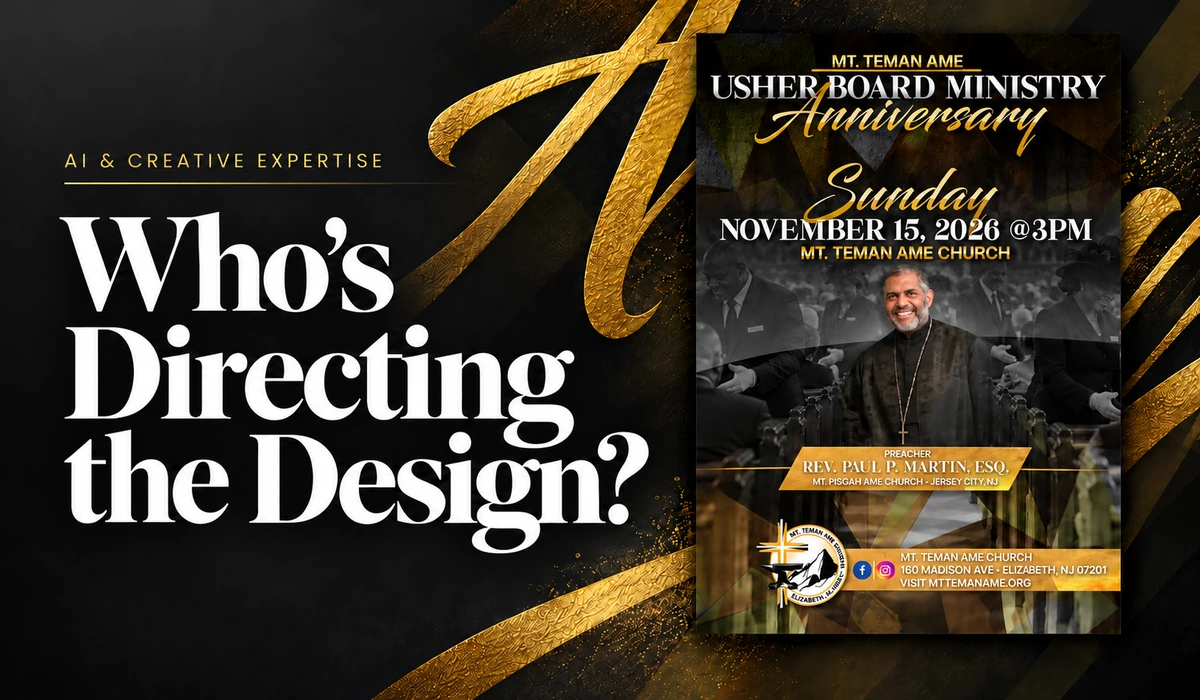
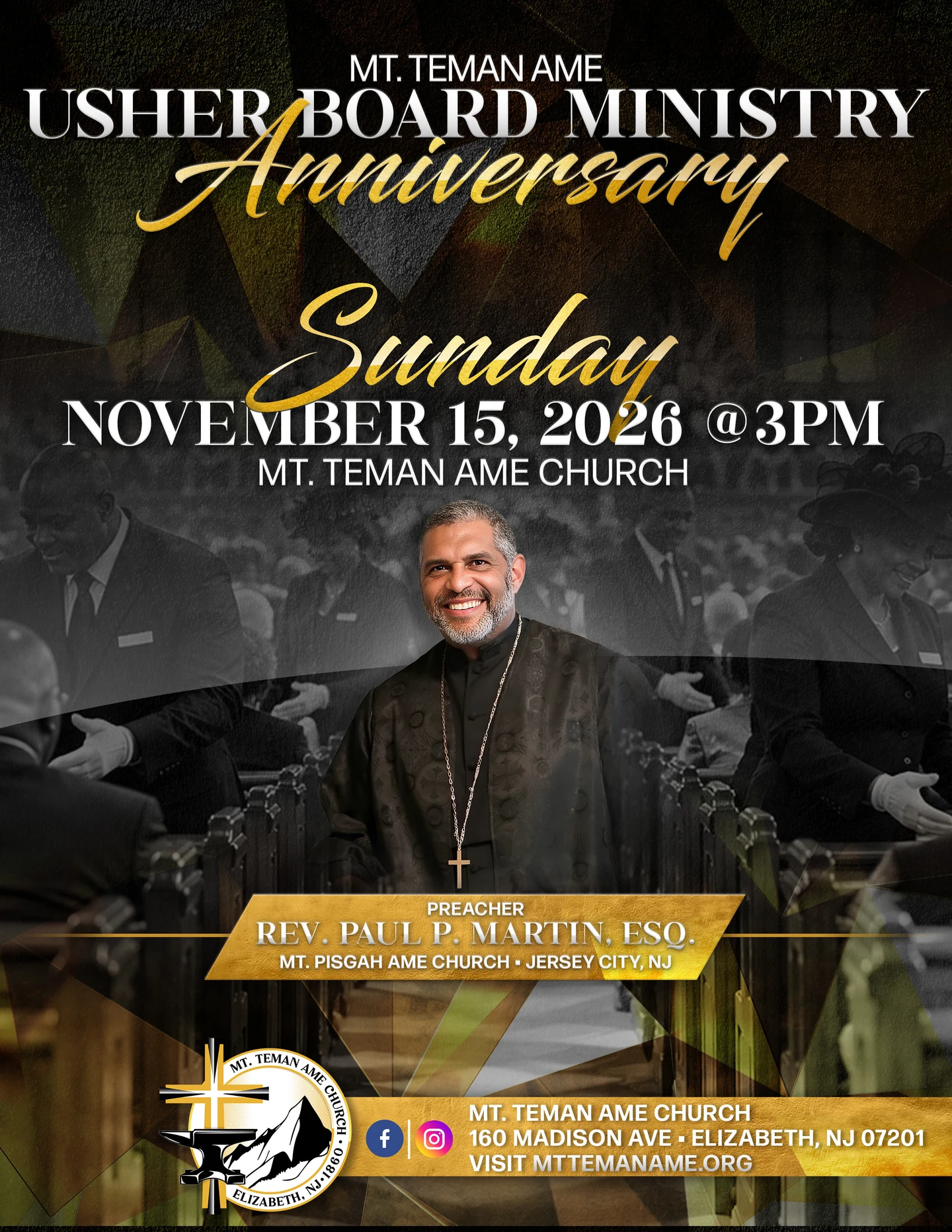
Recently, I was developing promotional artwork for the 2026 Usher Board Ministry Anniversary at Mt. Teman AME Church, a longtime Remeoner client.
The assignment called for imagery featuring male and female church ushers, supported by a black, white, and gold color scheme.
Finding an appropriate stock photograph would have been challenging.
Instead, I used ChatGPT to generate a photorealistic church interior depicting ushers assisting congregants inside a crowded sanctuary.
The generated image provided the visual foundation I needed.
From there, I moved into Adobe Photoshop, incorporating established client branding, typography, textures, gradients, and other elements to develop the finished composition.
One detail in particular prompted me to reconsider the relationship between technical execution and design expertise.
The Gold Lettering
The words Anniversary and Sunday featured metallic gold script typography.
The treatment wasn’t simply a font with a gold color applied.
I selected the typeface, masked a metallic texture into the lettering, introduced gradient highlights to simulate reflected light, applied subtle bevel-and-emboss effects, and used shadows to create separation and depth.
Each element served a purpose and could be adjusted independently.
If the gold needed more depth, I could modify the texture. If the highlights were too strong, I could reduce them without rebuilding the composition.
That control came from understanding how the effect was constructed.
Initially, I considered this a meaningful distinction between professional design and AI-generated artwork.
But then I challenged my own thinking.
What if AI could produce the same lettering, with the same level of control, without requiring any of those manual techniques?
As the technology evolves, that possibility becomes increasingly realistic.
And if the result is comparable, does the method of execution still define the expertise?
I don’t believe it does.
Knowing how to construct metallic lettering in Photoshop demonstrates technical proficiency.
But knowing why that lettering belongs in the composition, what it contributes to the message, and whether it should be used at all demonstrates something different.
Design judgment.
And the client interaction that followed provided a timely reminder of what that judgment looks like in practice.
When the Client Asked for a Change
The day after submitting the initial artwork, I received a call from the client.
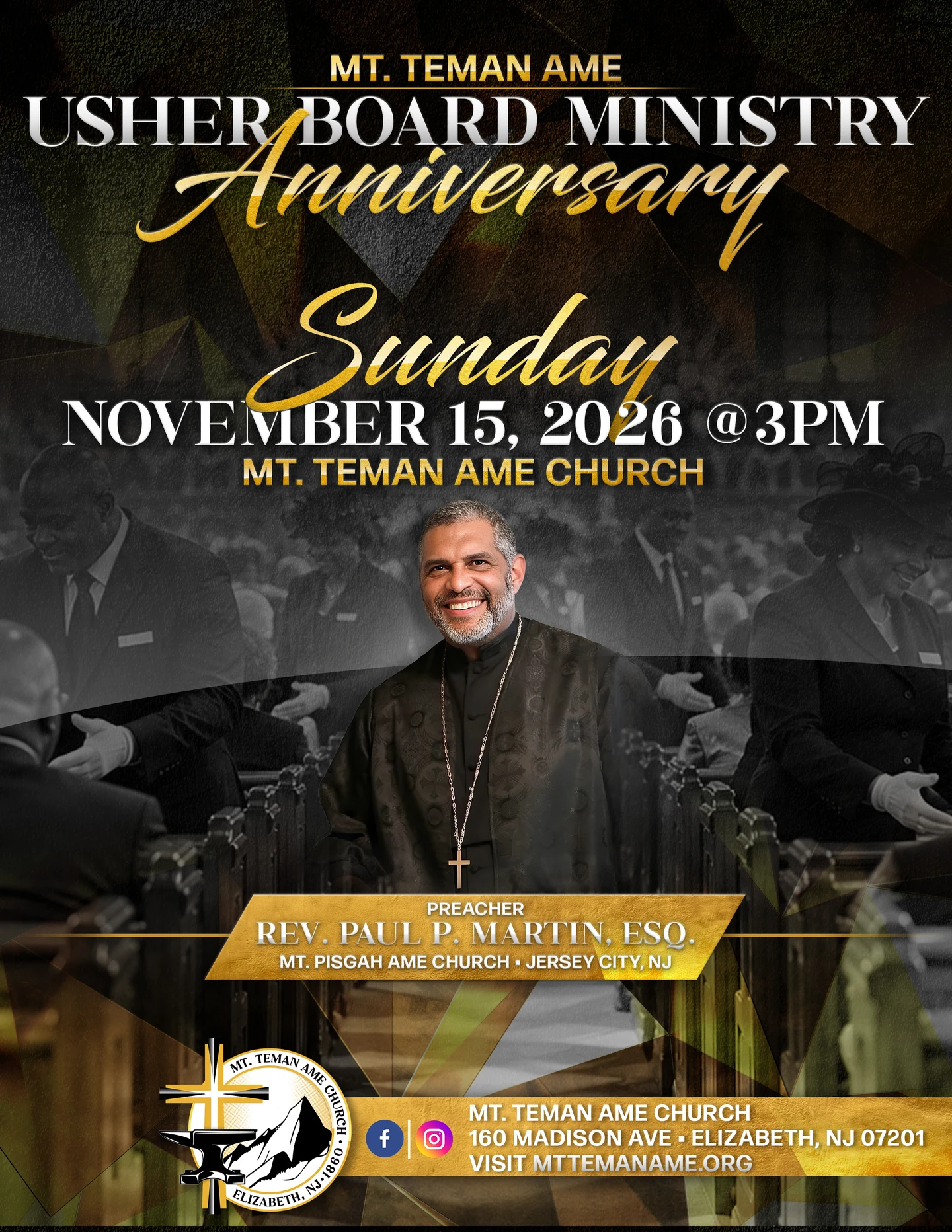
He loved the design but wanted more attention brought to the church’s name at the top.
The conversation went a little further.
He also questioned why I used “Mt. Teman AME” above the event title but “Mt. Teman AME Church” beneath the date.
I explained that the two references served different purposes.
At the top, “Mt. Teman AME” identified the organization presenting the Usher Board Ministry Anniversary. Including “Church” in that particular arrangement would have made the event title read awkwardly.
Beneath the date and time, however, “Mt. Teman AME Church” identified the event location.
He understood the distinction and agreed.
The conversation wasn’t about whether I could change the lettering. It was about why the information had been organized that way in the first place.
I subsequently revised the artwork and prepared the finished versions for print and social media.
The technical revision was only one part of the service. Explaining the design decision, considering the client’s feedback, and maintaining the intended communication were equally important.
Could AI have helped make those revisions? Certainly.
But that wasn’t the point.
The value of the interaction came from understanding what the client wanted, explaining the reasoning behind the design, and making an informed adjustment without compromising the composition.
And that brings us to a broader distinction.
Attractive Artwork Isn’t Necessarily Effective Design
Consider a promotional graphic for a community event.
It features dramatic lighting, elaborate typography, beautiful imagery, and an impressive composition.
At first glance, it looks great.
But the event date is difficult to find. The organization’s name gets lost among decorative elements. The most important information competes for attention.
The artwork may be visually appealing, but is it accomplishing its purpose?
Commercial design isn’t simply about making something attractive.
It’s about communicating.
Typography establishes hierarchy. Color influences perception. Composition guides attention. Imagery creates context. Branding builds recognition.
Each decision should support what the audience needs to understand or do.
Sometimes, the strongest design decision is knowing what to leave out.
The difference between attractive artwork and effective commercial design isn’t necessarily how it was produced. It’s whether the creative decisions support the intended purpose.
That standard applies regardless of the tools involved.
Someone can spend hours manually constructing an impressive composition that fails to communicate.
Someone else can use AI to produce an effective promotional graphic in minutes.
The amount of labor invested doesn’t determine the quality of the design.
Neither does the sophistication of the technology.
What matters is whether the person directing the work understands the communication problem and can recognize when the solution succeeds—or falls short.
That raises a more consequential question: How much control does the person directing the work actually have over the creative decisions being made?
Creative Autonomy: Understanding What to Direct and What to Delegate
Creative autonomy is the ability to make informed creative decisions, determine what to delegate, evaluate the results, and retain meaningful control over the intended outcome.
That definition doesn’t require Photoshop.
It doesn’t exclude artificial intelligence.
And it doesn’t favor one generation over another.
Every designer depends on tools.
I rely on Adobe’s creative applications and other technologies. An AI-native creative may rely primarily on generative platforms.
Neither of us operates independently of technology.
The distinction is how we exercise control over the work.
When someone asks AI to generate a promotional image, the system makes numerous decisions about lighting, perspective, composition, texture, and visual relationships.
Some align with the user’s intentions. Others may not.
The person directing the process can accept the result, reject it, refine the instructions, or pursue another approach.
That process can involve genuine creative expertise.
But it raises an important question.
Do we understand which decisions we’re making and which decisions we’re allowing the technology to make for us?
Creative autonomy isn’t about controlling every pixel or manually executing every technique.
It’s about recognizing which decisions matter and retaining the ability to influence them.
Interestingly, research published in Behavioral Sciences in April 2026 examined the relationship between creative control and AI-assisted design.
In a scenario-based study involving 226 designers and design students, researchers Wenyue Gong and Xiang Chen found that greater creative control had competing effects: it could strengthen psychological ownership while also increasing cognitive demands. Design experience influenced those relationships. PubMed Central (PMC)
The findings suggest that maintaining more control isn’t necessarily beneficial in every situation. The challenge involves balancing creative direction with the demands of managing the process.
That research adds an interesting dimension to something I’ve come to recognize through my own work.
Creative autonomy isn’t the absence of automation. It’s the ability to remain intentional while using it.
Suppose an AI-generated composition is visually compelling, but its typography competes with the central message.
The person directing the work must recognize the problem before determining how to address it.
AI may offer several solutions. Some may improve the communication. Others may simply make the composition more elaborate.
Knowing which direction to pursue requires judgment.
And knowing when to reject an impressive result because it doesn’t serve the intended objective is equally important.
That understanding also becomes valuable when circumstances change.
Software evolves. Production requirements shift. Client expectations develop.
Expertise tied exclusively to one application can become vulnerable when that application no longer meets the need.
The more durable form of creative expertise is the understanding that allows us to adapt our approach while remaining focused on the intended outcome.
But creative autonomy isn’t limited to the designer.
Increasingly, clients are developing their own creative capabilities.
And that’s where this conversation becomes particularly interesting.
When the Client Becomes More Independent
I’ve provided professional design services to Mt. Teman AME Church for approximately four years.
Over that time, Remeoner has developed promotional artwork, banners, programs, reports, and other communications supporting the church’s activities.
Like many organizations, Mt. Teman has committees responsible for different ministries, events, and initiatives.
Committee members have occasionally developed their own promotional materials.
I would describe much of that work as quick and dirty—simple designs intended to communicate an announcement or support an immediate need.
Not every announcement requires an elaborate creative production process.
Sometimes the objective is simply to get the information out.
Then generative AI became increasingly accessible.
Committee members began producing more sophisticated promotional artwork independently.
And some of it was genuinely impressive.
But there was a recurring issue.
While the designs could be visually appealing, they didn’t always satisfy established branding guidelines or technical production requirements.
Dimensions were incorrect. Formatting needed adjustment. Established branding elements weren’t always incorporated properly.
So I began receiving AI-generated artwork that needed professional corrections.
The client was no longer necessarily asking me to develop the initial creative concept.
They had already created something they liked.
They needed help making it suitable for its intended use.
AI hadn’t eliminated the need for my expertise. It had changed when and how that expertise was needed.
Apparently, I’m not alone in experiencing this shift.
In an October 2026 Fast Company article examining how AI is changing relationships between graphic designers and their clients, journalist Rachel Kurzius interviewed more than a dozen designers.
Some described receiving AI-generated concepts from clients who expected them to correct or refine the work rather than develop original ideas. Others reported pressure on their fees and reduced opportunities to contribute creative direction.
I recognized the situation immediately.
But my experience with Mt. Teman led me to consider a different response.
Rather than viewing the client’s growing independence solely as a reduction in traditional design work, I began examining whether there was an opportunity to redesign the process itself.
From Correcting Artwork to Designing the Process
I could continue addressing those recurring issues individually.
Every committee announcement that required adjustment could become another small production assignment.
But I began considering whether the requirements themselves could be incorporated into a repeatable system.
The church already had established branding guidelines.
Certain promotional formats required specific dimensions.
The placement of familiar branding elements followed conventions developed through years of working with the organization.
Those requirements didn’t need to be reconsidered from the beginning every time someone created an announcement.
What if committee members could continue creating their own artwork while a purpose-built tool helped bring that artwork into alignment with the church’s established standards?
That question led to the development of the Mt. Teman Promo Creator, a custom AI-assisted plugin developed by Remeoner.
The purpose was specific.
It wasn’t intended to replace all professional design services provided to the church.
It wasn’t designed to create every type of promotional or organizational material.
And it wasn’t intended to make every creative decision on behalf of committee members.
The Promo Creator was developed to support a particular category of work: routine promotional artwork created by committee members using AI.
The tool incorporates defined branding guidelines and technical specifications, including established branding elements, placement conventions, and standardized output dimensions.
Committee members can continue exploring their own creative ideas.
The tool is designed to help apply the requirements needed to prepare those materials for their intended formats.
Meeting technical specifications doesn’t automatically guarantee that every composition communicates effectively. Design judgment still matters.
But recurring production requirements can be addressed more consistently through a system developed specifically for that purpose.
I wasn’t trying to create a tool that could design everything. I was creating a tool that could help solve a recurring production problem.
And there is an important distinction between those two objectives.

When Expertise Becomes Part of the System
The Mt. Teman Promo Creator represents a change in how Remeoner delivers a portion of its professional expertise.
Traditionally, much of that expertise was applied directly to individual assignments.
A client needed artwork. I developed it.
A client needed revisions. I made them.
A client needed materials prepared for a particular format. I handled the production requirements.
That remains part of Remeoner’s business.
Original creative assignments will continue to require professional design services.
But certain recurring production needs can now be addressed through a purpose-built system informed by that same experience.
The expertise hasn’t disappeared. Its application has expanded.
And here’s where the business implications become significant.
Mt. Teman paid Remeoner to develop the Promo Creator.
That development represents a different revenue opportunity from creating individual promotional graphics.
The tool may also require support as the church’s needs evolve. New functionality, additional specifications, and future enhancements can become separate paid services.
More importantly, the underlying framework creates an opportunity to develop similar tools for other organizations.
But those tools would need to reflect each client’s particular requirements.
A system intended for routine promotional announcements serves a different purpose than one designed to produce an annual report.
An annual report introduces different considerations: editorial structure, typography, pagination, photography, data presentation, and publishing requirements.
Those aren’t simply additional features to add to a general-purpose promotional tool.
They represent a different production problem.
And potentially, a different product.
The principle is the same: understand the client’s requirements, identify which aspects of the process can be standardized, and develop a solution appropriate to that purpose.
Sometimes professional expertise is delivered through the finished artwork. Sometimes it’s incorporated into the system that helps the client produce the artwork.
Both approaches create value.
They simply deliver it differently.
Client Independence Changes the Business Relationship
There’s an economic reality here that shouldn’t be overlooked.
As AI gives clients the ability to produce more artwork independently, their need for certain traditional design services may decrease.
That’s a legitimate concern for creative professionals whose revenue depends heavily on individual production assignments.
Ignoring that possibility doesn’t make it disappear.
But increased client independence can also create demand for different services: custom workflow development, brand-governed production tools, technical implementation, ongoing support, functional enhancements, and specialized creative direction.
These opportunities don’t automatically replace lost production revenue. Their value depends on client demand, implementation costs, adoption, and the ability to deliver meaningful results.
But the Mt. Teman experience demonstrates that the opportunity exists.
Rather than treating the church’s growing creative independence as something to resist, I looked for a way to support it.
Remeoner was compensated for developing the tool.
The church gained a system intended to help committee members handle routine promotional materials more independently.
And professional design services remain available for assignments requiring original creative development or more extensive production work.
The relationship didn’t end.
The way we collaborate began to evolve.
That’s an important distinction because the future of professional design isn’t necessarily a choice between doing everything for the client and letting the client do everything independently.
There is considerable room between those two approaches.
AI can help designers become more efficient.
It can help clients become more capable.
And professional expertise can help establish the processes, standards, and systems that allow those capabilities to work together.
The Designer’s Role Is Expanding
When I began thinking about this subject, I was focused on the distinction between AI-generated artwork and the technical expertise required to construct professional designs.
The gold lettering in the Mt. Teman anniversary artwork seemed like a useful example.
And it was.
But the more I examined the experience, the more I realized the technical process wasn’t the most consequential part of the story.
AI had changed how I produced one component of the artwork.
At the same time, it was changing how my client approached creative production.
That required me to reconsider not simply how I worked, but how Remeoner could continue providing value as the client’s capabilities evolved.
The resulting solution wasn’t another graphic.
It was a tool designed to address a recurring need.
That doesn’t mean every designer needs to become a software developer.
Nor does it suggest that every creative assignment should be automated.
Professional designers will continue producing original artwork, developing campaigns, building brands, and solving communication problems that benefit from direct creative involvement.
But the ways we deliver that expertise are expanding.
Some designers may focus on original creative direction.
Others may develop production systems, manage brand standards, or help organizations incorporate AI into their workflows.
Many will do some combination of those things.
The opportunity isn’t to abandon traditional design expertise.
It’s to recognize where that expertise can contribute value as the production process evolves.
Who’s Directing the Design?
The answer may depend on what we’re creating and how the work is being accomplished.
Sometimes the designer develops the creative concept and executes the finished artwork.
Sometimes the client generates the initial design, with AI assisting in the production process.
And sometimes the designer develops the framework that helps the client produce materials within established branding and technical standards.
These approaches aren’t mutually exclusive.
They’re different ways creative responsibilities can be organized.
For me, the Mt. Teman experience brought that realization into focus.
AI improved my ability to produce certain visual assets.
It also gave members of the church greater independence in producing their own promotional artwork.
And that change created an opportunity to deliver my professional expertise through a different kind of service.
The same technology that reduced the client’s dependence on me for certain production tasks created an opportunity for me to build something that supported their independence.
That doesn’t eliminate the importance of creative judgment, autonomy, or accountability.
It demonstrates how those qualities can be applied beyond an individual design assignment.
The question is no longer simply whether AI can produce artwork comparable to what a professional designer might create.
It can.
The more consequential question is what designers do as those capabilities become increasingly accessible to the people they serve.
My experience suggests that the answer isn’t necessarily to defend the old process or surrender the work to automation.
It’s to understand what has changed, recognize what clients still need, and develop solutions that make sense for both.
A designer doesn’t have to create everything to remain valuable. Sometimes the value lies in designing a better way for others to create.
Jason “Remeoner” Ellington is the founder of Remeoner, LLC, providing graphic design, branding, marketing strategy, and integrated marketing and design solutions for businesses and nonprofit organizations.
Powered by Remeoner.