AI has opened an enormous warehouse of possibilities for business owners. But discovering what the tools can do is only the beginning. The real challenge is determining which ones actually improve your business—and whether they deliver the freedom you expected.
Welcome to the AI Warehouse
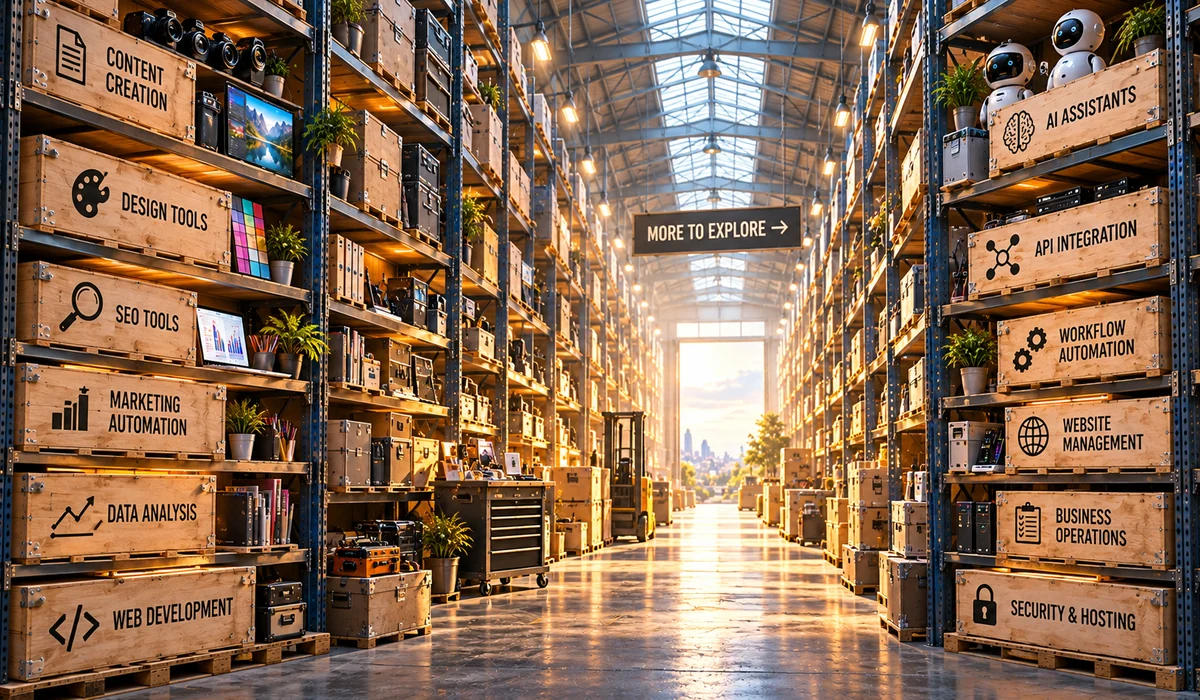
Imagine walking into a warehouse filled with an almost endless assortment of tools.
Tools everywhere.
Some look familiar. Others, you have no idea what they’re capable of. Some can perform tasks you’ve been doing manually for years. Others make things possible that you hadn’t even considered.
And every time you turn a corner, there’s something else.
That’s how I began to visualize artificial intelligence when I started seriously exploring what it could do for my business.
The possibilities seemed enormous.
But so did the questions.
How am I supposed to know all these tools exist? And once I discover them, how do I know I’m using them effectively?
Because here’s the thing.
Having a warehouse full of tools doesn’t automatically make you more productive.
You still need to know what’s available, understand how to use what you find, and determine whether introducing another tool will improve anything.
I approached AI through a commercial lens.
I wasn’t looking for a business to start. I already had one.
I was looking for ways to make the business I’d spent years developing operate better.
And that’s where my journey through the warehouse began.
I Didn’t Need a New Business. I Needed Better Tools.
Remeoner has always operated as an ecosystem of professional services.
Graphic design, photography, videography, web development, SEO, marketing strategy, web hosting, and website management are all part of that ecosystem.
Some clients know me as their photographer. Others know me as their web developer. Still others work with Remeoner across several disciplines under a single agreement.
Each service can operate independently, but I’ve always understood the value of having them work together.
AI didn’t introduce me to that concept.
What it introduced was the possibility of improving the infrastructure supporting those services.
For example, I’d been providing SEO services long before AI became part of my workflow.
I understood the work, the deliverables, and the processes required to produce them.
But as I explored AI, I began recognizing patterns in tasks I performed repeatedly.
That led me to develop specialized tools, including my SEO Workup tool.
Instead of repeatedly preparing similar instructions, I could use a structured process to generate SEO recommendations, optimized filenames, metadata, and other content elements.
The tool improved the consistency and efficiency of my work.
And it introduced an important distinction.
Optimization doesn’t always mean doing something faster. Sometimes it means producing a better result with the resources you already have.
The more I explored, the more opportunities I discovered to strengthen processes that were already working.
And then I found Codex.
Then I Discovered Codex
Discovering Codex was almost like being a kid in a candy store.
By then, I’d already developed several useful AI tools. But considerable manual work remained between generating an optimized deliverable and implementing it.
Take image optimization.
My SEO Workup tool could recommend an optimized filename.
Great.
But I still had to open Adobe Bridge, locate the file, and rename it myself.
With Codex, I could provide access to the project directory and have it perform that operation directly.
Now we’re talking.
Naturally, that discovery raised another question.
If it could rename files, could it upload them to WordPress?
Could it create article drafts?
Could it apply metadata?
Could it schedule content?
Could I connect these processes and eliminate much of the repetitive work involved in preparing and publishing content?
For years, I’ve encouraged clients to use content calendars.
I’d tell them they could sit down on a lazy Sunday afternoon with a glass of wine, plan their content for the month, and begin preparing posts a couple of weeks in advance.
The calendar provides structure. Advance preparation helps maintain consistency.
That advice still holds.
But with sufficient context, appropriate source material, and necessary digital assets, AI can help develop a monthly content calendar and prepare its associated posts considerably faster.
And with API integrations, portions of the publishing process can be automated.
Imagine establishing the parameters, initiating the workflow, and allowing the system to handle the repetitive work.
Tell the machine what to do and walk away.
At least, that was the idea.
Then the Breakpoints Discovered Me
As I experimented with more sophisticated automation, I discovered that making individual tools work was one thing.
Making them work together reliably was another.
Sometimes everything worked as expected.
Other times, fixing one issue created another.
I’d solve one problem only to discover that something else had stopped working.
And occasionally, I’d spend more time developing the automation than completing the original assignment would have required.
That’s when terms like use cases, edge cases, and human intervention points became part of my everyday vocabulary.
A workflow might function beautifully under normal conditions but encounter problems when something unexpected happens.
A file might be missing. An API might reject a request. The data might not match the expected format.
Suddenly, the process that was supposed to operate independently required my attention.
Time spent developing. Time spent testing. Time spent troubleshooting. And time spent correcting something that was supposed to save time in the first place.
That’s when I began looking at automation differently.
I wasn’t just evaluating what AI could accomplish.
I was evaluating what it actually cost to make those accomplishments possible.
And for me, that cost usually came down to time.
Time I could have spent completing client work. Time I could have spent pursuing another opportunity. Or time I could have spent doing something other than sitting in front of a computer trying to make an automation behave.
Research published by MIT Sloan in September 2026 examined a similar challenge.
Researchers found that converting AI experiments into organizational solutions required substantial additional work, including testing capabilities, refining outputs, and adapting implementations as the technology evolved. Without sufficient support for that work, AI initiatives could lose momentum.
That finding resonated with me.
When you’re operating a small business, the person performing all that additional work may also be responsible for delivering the original assignment.
And there’s only so much time available.
Sometimes the Better Decision Is to Keep a Step Manual
Let’s return to my SEO workflow.
Originally, I’d generate optimized filenames through my SEO Workup tool and rename the files manually.
Codex allowed me to automate the renaming process.
Naturally, I explored automating the next step: uploading those files into WordPress.
Browser control offered one approach, but I found that its additional complexity and execution costs didn’t justify automating the upload through the methods I was using.
Meanwhile, uploading the files myself was straightforward.
So I adjusted the workflow.
Now, I can have Codex rename the project files, upload them into WordPress manually, and then use API connections to locate those assets in the media library and prepare subsequent deliverables, including article drafts.
It’s not an entirely automated process.
And that’s okay.
The objective was never supposed to be automation for its own sake. The objective was to improve the workflow.
Could I continue experimenting until I eliminate that manual step?
Possibly.
But should I?
That’s the more important question.
I’ve come to recognize that human intervention isn’t necessarily a weakness in an automated workflow.
Sometimes it’s a necessary safeguard. Other times, it’s simply the most efficient way to complete an activity.
The challenge is knowing the difference.
But Has It Actually Created the Freedom You Expected?
This question has become increasingly important as I continue exploring the warehouse.
One of automation’s greatest attractions is the possibility of reclaiming time.
But what happens when an automation requires more attention than the task it was designed to replace?
Have you actually gained anything?
I have an advantage when evaluating these experiments because I’ve been performing many of these tasks for years.
I generally know how long they take without AI.
That gives me a baseline.
When I introduce an AI-assisted improvement, I can compare the new process against the existing one.
How much time did I spend developing it?
How much time does it save?
Does it require ongoing intervention?
Does it produce a better result?
And is it worth using again?
Successfully automating a task isn’t necessarily the same as successfully optimizing a workflow.
Sometimes the improvement creates immediate value.
Other times, the initial investment only becomes worthwhile when the process is repeated across multiple projects.
And sometimes, the improvement never justifies the effort.
That doesn’t necessarily make every unsuccessful experiment a waste. Developing an automation can introduce skills or capabilities that become useful elsewhere.
But the possibility of future value shouldn’t become an excuse for unlimited experimentation.
At some point, you have to make a business decision.
Keep developing. Modify the process. Introduce a human intervention point.
Or put the tool back on the shelf.
And time isn’t the only consideration.
My SEO Workup tool, for example, improved the structure and consistency of my deliverables. That has value even when the time savings aren’t substantial.
Other improvements might reduce errors, strengthen service quality, or make an existing capability easier to deliver across multiple clients.
AI has also enabled me to pursue opportunities I might previously have passed over—not because I lacked the expertise, but because the production demands made pursuing them less attractive.
That’s an economic benefit worth considering.
But none of these benefits should be assumed simply because new technology has been introduced.
They have to be demonstrated through the work.
The Tools Don’t Eliminate the Responsibility
There’s another dimension of my experience that business owners should consider.
Understanding what happens behind the scenes matters.
Throughout 2026, I encountered increasingly complex website hosting, security, PHP compatibility, and server-management issues.
AI became a valuable source of technical guidance as I investigated and addressed those problems.
In several instances, it helped me perform work that might otherwise have required outside technical support.
That saved money.
It also expanded my understanding of the systems I manage.
But AI wasn’t assuming responsibility for those websites.
I was.
I still needed to understand the environment, evaluate the instructions, implement changes, and verify the results.
And when something breaks, it’s still my responsibility to address it.
That’s why I’m cautious about surrendering too much control simply because AI can execute a task.
Someone may generate a functioning website without understanding much about its architecture or maintenance requirements.
But what happens when something stops working?
The same question applies to experienced professionals who become overly dependent on technology they don’t adequately understand.
AI can help people develop capabilities they didn’t previously possess. I’ve experienced that firsthand.
But producing an outcome and understanding how to support that outcome are two different things.
The tools may expand what we’re capable of accomplishing, but they don’t automatically eliminate our responsibility for what we deliver.
That same responsibility applies to creative work, as I explored in AI Can Create the Artwork. Who’s Directing the Design?.
I’m Still Walking Through the Warehouse
I haven’t figured out everything AI can do.
Not even close.
And I don’t expect to.
New tools continue to emerge. Existing capabilities evolve. Things that required considerable effort several months ago may become easier tomorrow.
I’m still discovering what’s available.
Still experimenting.
Still encountering unexpected challenges.
And occasionally, still spending more time than I intended trying to make something work.
But my perspective has changed.
When I first imagined the warehouse, I was primarily concerned with discovering the tools.
Now I’m increasingly concerned with understanding where they belong.
Which ones can strengthen the services I already provide?
Which ones improve established workflows?
Which ones create opportunities that previously weren’t economically practical?
And which ones introduce more complexity than they’re worth?
I suspect other experienced business owners have encountered similar questions.
Perhaps you’ve experimented with an AI tool that promised to simplify a process.
Maybe it worked.
Maybe it created unexpected complications.
Or perhaps you abandoned the experiment because the original process was easier.
I’ve been there.
And in some instances, I’ve continued experimenting long enough to develop an approach that delivered meaningful improvements.
In others, I’ve accepted the limitations and moved forward with a more practical solution.
Those experiences have become part of how I approach workflow optimization at Remeoner.
Not by assuming every business needs more AI.
Not by suggesting every manual activity should be automated.
But by examining how the work is actually performed, identifying opportunities for improvement, and determining whether the available tools can deliver meaningful value.
Because the warehouse isn’t going anywhere.
There will always be another tool to discover. Another capability to explore. Another opportunity to reconsider how something gets done.
You don’t have to master the warehouse to benefit from it.
You just have to become more intentional about what you take off the shelves.
And sometimes, knowing when to put something back is just as valuable.
Remeoner, LLC provides marketing, design, web development, SEO, and digital business solutions. We combine creative expertise, technology, and strategic thinking to help businesses and organizations strengthen their brands, improve their operations, and pursue new opportunities.
Powered by Remeoner.
Supplemental FAQ: AI Workflow Optimization
What is the AI Warehouse analogy?
The AI Warehouse is a metaphor for the enormous collection of capabilities available through artificial intelligence. For business owners, the challenge is discovering those capabilities, understanding their applications, and deciding which tools create meaningful operational value.
Does AI automation always improve business productivity?
No. AI automation can reduce repetitive work, improve consistency, and expand operational capacity. However, implementation, testing, troubleshooting, and ongoing supervision can offset those benefits. Successful optimization requires evaluating the entire workflow.
How should businesses decide which workflows to automate?
Businesses should begin with an established process, understand its existing time and resource requirements, and identify specific opportunities for improvement. AI-assisted alternatives can then be tested against the original workflow for efficiency, quality, reliability, and ongoing maintenance costs.