
Why professional experience remains a competitive advantage in an AI-powered business environment.
You’ve Tried AI. Now What?
Maybe you’ve asked ChatGPT to develop a marketing strategy, used Gemini to write website content, or turned to Claude to troubleshoot a technical problem.
Some of those experiments worked. Others produced results that looked impressive but fell short when you tried putting them into practice.
And perhaps you’ve encountered the most frustrating outcome of all: an AI-generated answer that sounded convincing, but you weren’t entirely sure whether you could trust it.
The relationship between AI and professional expertise is becoming increasingly important for businesses discovering what these tools can accomplish—and what still requires experienced judgment.
Welcome to one of the defining challenges of the AI era.
Powerful capabilities are now available to almost anyone. But having access to those capabilities and knowing how to apply them professionally are two different things.
That shouldn’t discourage you from experimenting. In fact, your willingness to explore AI may be one of the smartest investments you’re making in your business.
The question is what happens when you combine those capabilities with someone who understands the work you’re trying to accomplish.
Everyone Has Access to the Warehouse
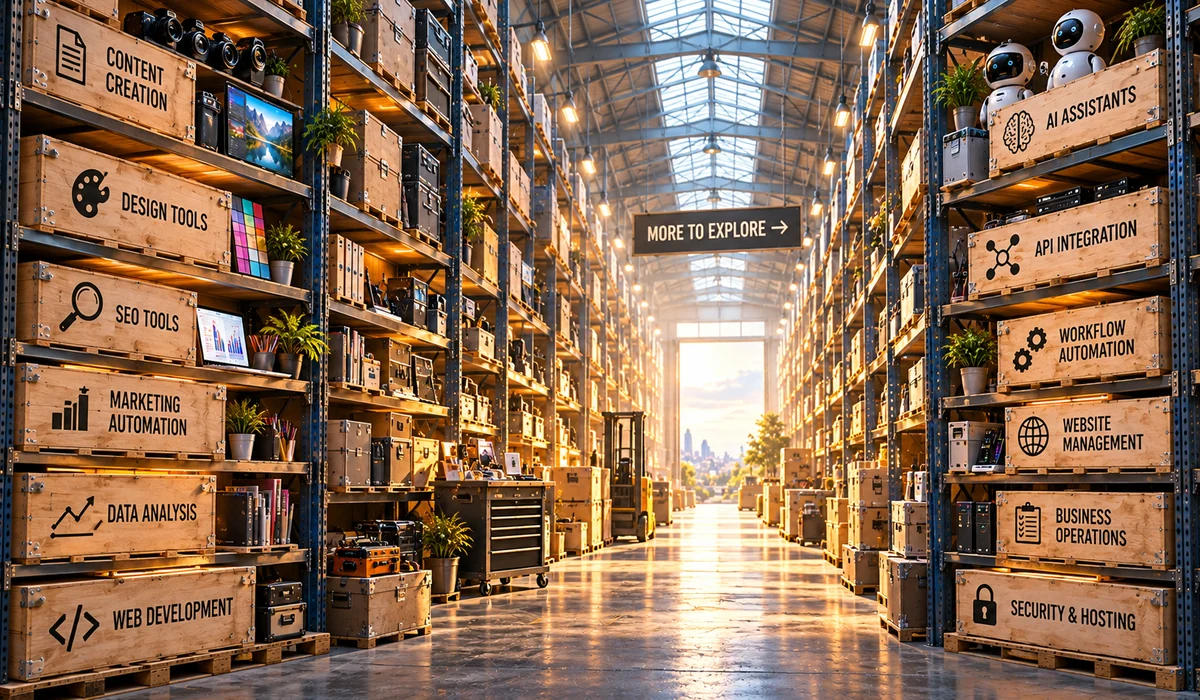
In an earlier article, I compared today’s AI environment to an enormous warehouse filled with tools, equipment, and resources.
The doors are open, and the barriers to entry are lower than ever.
You can generate code without being a software developer, produce advertising concepts without being a creative director, or develop SEO metadata without understanding search engine optimization.
That’s extraordinary access.
But walking into a fully equipped workshop doesn’t automatically make someone a master craftsman.
Consider two people standing in the same woodworking shop. One has spent twenty years designing and building furniture. The other recently learned how to operate the equipment.
Both can use the machinery. Both may produce something worth keeping.
But the experienced furniture maker brings an understanding of materials, structure, proportions, durability, and craftsmanship that influences every decision.
The equipment enhances what each person can accomplish. It doesn’t erase the difference in their experience.
The machines don’t eliminate craftsmanship. They change how craftsmanship can be practiced.
And that brings us to an increasingly important question about AI.
When Did Using AI Make Everyone an Expert?
We’ve witnessed an explosion of AI tools, accompanied by an equally impressive number of people positioning themselves as experts.
Some have earned that distinction through years of technical work, research, implementation, and practical experience.
Others have become proficient with a particular platform and begun presenting that proficiency as expertise in disciplines they may barely understand.
There’s a difference.
A senior software developer who masters Claude Code may be exceptionally skilled at AI-assisted programming. That doesn’t automatically qualify them to direct an advertising agency, develop a brand strategy, or evaluate a client’s marketing campaign.
Likewise, a seasoned creative director who becomes proficient with AI-assisted design doesn’t automatically qualify as an enterprise software architect.
Both professionals may possess considerable expertise. Neither gains authority over an unrelated discipline simply by learning a powerful tool.
And this isn’t an argument against learning new skills. AI makes exploration and professional development more accessible than ever.
It’s an argument against confusing access with mastery.
Knowing how to use AI is a skill. Knowing what you’re doing with it is another.
The Difference Between Producing Work and Understanding It
Consider search engine optimization.
Ask an AI model to write an SEO title and meta description, and you’ll likely receive a polished response within seconds.
But is the title aligned with the page’s actual purpose? Does the description speak to the intended audience? Are the keywords relevant to what prospective customers are searching for? How does the page fit into the website’s overall content strategy?
Those are questions that require knowledge beyond generating text.
Before AI became part of my workflow, I was already researching keywords, writing metadata, organizing website content, and implementing SEO strategies for clients.
The work was familiar. The process was simply slower.
AI allowed me to improve that process: developing metadata faster, applying established SEO practices more consistently, and incorporating additional considerations without repeating every manual step.
Eventually, that evolution contributed to the development of the Remeoner SEO Workup Tool, a structured approach to preparing and evaluating website content and SEO metadata.
But AI didn’t introduce me to SEO.
My existing knowledge helped determine what the tool needed to accomplish, which standards it should support, and where professional judgment remained necessary.
Someone unfamiliar with SEO can use AI to generate metadata. An experienced professional can use AI to develop, evaluate, and implement metadata within a broader search strategy.
The tool didn’t create the expertise. The expertise shaped the tool.
That’s the difference between simply producing an output and understanding the work behind it.
When the AI Answer Isn’t Enough
Now imagine your WordPress website suddenly becomes inaccessible.
You describe the problem to an AI model, and it suggests disabling plugins, increasing PHP memory, clearing the cache, or modifying your website configuration.
Those recommendations may be reasonable possibilities. But which one addresses the actual problem?
What if the issue isn’t WordPress itself?
It could involve exhausted hosting resources, a PHP configuration conflict, a failed scheduled task, or security software interfering with legitimate requests.
Each possibility requires a different investigation.
An experienced WordPress professional understands the relationship between the website, its hosting environment, its software dependencies, and the systems supporting it.
AI can assist with interpreting error messages, evaluating diagnostic information, and exploring possible causes.
But knowing what to investigate, what evidence to trust, and what changes could introduce additional problems requires professional judgment.
That’s why Remeoner approaches WordPress stability and modernization by investigating the underlying system rather than treating every visible symptom as an isolated problem.
An answer is useful. Understanding whether it’s the right answer is where experience earns its value.
With the right guidance, business owners can use AI to better understand their technology while relying on experienced professionals to evaluate risks, implement appropriate solutions, and maintain the systems their businesses depend on.
You Don’t Have to Choose Between AI and Professional Help
Here’s where I think the conversation about AI needs to evolve.
Business owners shouldn’t have to choose between exploring AI independently and hiring experienced professionals.
You’ve already demonstrated initiative by experimenting with the technology. Maybe you’re using it to draft content, develop campaign concepts, organize information, or better understand technical challenges.
Keep doing that.
But recognize that there will be situations where the next step requires more than another prompt.
You may need someone to evaluate your approach, implement a technical solution, refine a creative concept, or connect several disconnected activities into a coordinated strategy.
And sometimes you don’t need someone to take over the entire project.
You need a professional who can help you become more capable.

That might mean collaborating on a project, developing a repeatable workflow, providing training, establishing technical safeguards, or offering ongoing guidance as your business evolves.
The objective isn’t to make you dependent on professional services for every task.
It’s to help you recognize where your own capabilities can take you further and where specialized experience can improve the outcome.
AI expands what you can attempt independently. Professional expertise can help you accomplish more with it.
The Real Competitive Advantage
As AI becomes more accessible, generating content, code, artwork, and recommendations will become increasingly routine.
But producing more doesn’t necessarily mean producing something better.
A recent Fast Company article, “The ‘enslopification’ of B2B marketing is here”, examines how the proliferation of AI-generated content can contribute to generic, interchangeable marketing that lacks meaningful perspective.
That concern points to a larger issue.
When everyone has access to similar capabilities, the judgment behind their use becomes increasingly important.
Who understands the audience? Who recognizes the technical risks? Who can distinguish an attractive design from an effective communication strategy? Who knows whether the recommended solution actually addresses the business problem?
Those questions don’t disappear because AI makes production easier.
They become more important.
And for businesses evaluating professional services, the questions are worth asking before making an investment.
Look beyond demonstrations of the latest AI tools. Examine professional experience, past work, and the reasoning behind recommendations.
The goal is to find someone who understands your business objectives and can use the appropriate technology to help achieve them.
Better Tools. Experienced Hands. Stronger Results.
I’ve spent more than two decades working across marketing, design, website development, and related technologies.
During that time, the tools have changed dramatically. The way we build websites, produce promotional materials, manage content, and communicate with audiences continues to evolve.
AI is another significant evolution.
But businesses still need clear communication, reliable websites, effective marketing, and technology that serves a practical purpose.
At Remeoner, AI has become part of how we improve established workflows, strengthen existing services, and develop more effective solutions for the businesses and organizations we serve.
Not because it replaces the experience behind the work, but because it allows us to put that experience to work in new ways.
And increasingly, that includes helping clients discover how they can use AI more effectively themselves.
The opportunity isn’t simply to hire someone who knows how to use AI.
It’s to work with someone who understands your business needs, possesses the professional expertise to address them, and knows how to bring modern technology into the process.
When everyone has access to powerful tools, the knowledge, experience, and judgment behind their use become more valuable, not less.
Let’s Put That Experience to Work for You
Already experimenting with AI but unsure how to translate those experiments into meaningful business results?
Whether you’re addressing WordPress problems, improving search visibility, developing your brand, or exploring more efficient marketing and technology workflows, Remeoner can help.
We combine established professional expertise with modern AI capabilities to solve problems, improve systems, and help businesses make better use of the technology available to them.
Schedule a FREE consultation with Remeoner to explore how we can put that combination to work for your business.
Questions About AI and Professional Expertise
Can AI replace professional expertise?
AI can help you produce content, code, and recommendations. It doesn’t automatically give you the experience to evaluate them. Professional expertise helps determine whether the result is accurate, appropriate, and useful for the business problem you’re trying to solve.
Why do businesses still need marketing professionals if they have AI?
Generating a campaign concept is one part of marketing. Understanding the audience, developing the message, and connecting individual activities to a business objective require judgment. An experienced marketing professional can help you evaluate your AI experiments and turn useful ideas into a coordinated strategy.
How can an experienced SEO professional use AI?
An experienced SEO professional can use AI to research ideas, develop metadata, organize content, and improve repeatable workflows. Their existing knowledge guides what to ask for, how to evaluate the output, and how to implement it within the website’s broader search strategy.
Should I use AI to troubleshoot my WordPress website?
AI can help explain error messages and suggest possible causes. But a convincing recommendation isn’t a diagnosis. Before making changes, an experienced WordPress professional can evaluate the evidence, assess the risks, and determine whether the problem involves the website, hosting environment, or another supporting system.