
Your reputation may be keeping you busy. But is your marketing preparing you for what happens when the phone stops ringing?
What if your biggest client called tomorrow and canceled their contract?
Not because you did anything wrong. Their priorities changed. Their budget disappeared. They decided to take the work in another direction.
Just like that, eight months of anticipated revenue becomes four.
Now ask yourself something.
If you needed three new clients within the next 60 days, how many people outside your existing network would even know to consider you?
That’s an uncomfortable question when business is good.
Your calendar is full. The invoices are getting paid. Your clients are happy. You’ve earned a reputation for delivering quality work, and one relationship has consistently led to another.
You’ve worked hard to build that business.
But somewhere along the way, you may have become so busy serving the people who already know you that you stopped introducing yourself to the people who don’t.
And that’s a vulnerability success can make remarkably easy to overlook.
Because being found isn’t the same as being discovered.
Being Busy Can Hide a Business Development Problem
There’s nothing wrong with building a business through referrals, relationships, and repeat customers.
For many service providers, those connections are the foundation of everything they’ve accomplished.
A satisfied client recommends you. Someone in your professional circle makes an introduction. A successful project opens the door to another contract.
That’s how reputations are built.
But there’s a difference between having a reliable network and having a reliable process for reaching new customers.
Your network knows who you are. They understand your capabilities, or they know someone who does.
Your potential market is much larger.
It includes people who have never heard your name, never visited your website, and never encountered your work—but who may need precisely what you offer.
And while you’ve been busy delivering for your existing clients, that audience has continued searching, comparing, researching, and making purchasing decisions.
The question is whether your business has been part of those conversations.
When a major contract ends or referrals slow down, the distinction becomes painfully clear.
There’s a related business risk when a large share of your revenue comes from just a few clients. Corporate Finance Institute describes it as customer concentration: losing even one major customer can significantly affect revenue and cash flow.
You may have spent years developing your expertise without spending nearly as much time developing awareness of that expertise beyond your existing relationships.
Suddenly, you’re not just looking for another contract.
You’re trying to reach an audience that doesn’t know you exist.
Your Business Has Evolved. Has Your Website?
Think about what your business looked like three years ago.
What services did you offer? What problems were you equipped to solve? What experience did you bring to the table?
Now consider everything you’ve learned since then.
You’ve completed projects, navigated challenges, developed new capabilities, and perhaps expanded into services you never anticipated offering.
Your business has evolved.
But has your digital presence kept pace?
Many businesses launch professionally designed websites that accurately represent their capabilities at that moment.
The website looks good. The services are clearly explained. The pages are optimized for search engines. Everything functions as intended.
Then the business owner gets back to running the business.
Months become years.
The website remains largely unchanged.
It may still rank for relevant searches. It may still generate inquiries. Nothing about remaining static automatically makes a website ineffective.
But there’s a difference between a website that continues functioning and one that continues representing the full value of the business behind it.
Your website doesn’t have to be broken to be underutilized.
Google’s SEO Starter Guide recommends reviewing existing content and updating it as needed. The useful question isn’t simply when you last changed a page. It’s whether that page still helps the people you want to reach.
And while your business has been changing, your prospective customers have been changing too.
They’re asking different questions, evaluating new solutions, reading reviews, and comparing providers based on concerns that may not have existed when your website launched.
You might have the experience to answer those questions.
You might already provide exactly what they’re looking for.
But if your website still communicates your original value proposition, those customers may never recognize the connection.
Your business has moved forward.
Your message may still be standing at the starting line.
Your Existing Audience Isn’t Your Entire Market
Social media can be an extraordinary business development tool.
Some businesses build loyal audiences, generate consistent revenue, and operate successfully without a traditional website.
Consider a caterer whose Instagram account showcases beautiful food, memorable events, and satisfied customers.
The work is visual. Customers share their experiences. Referrals circulate. Bookings follow.
If that approach supports the business’s goals, why insist on adding marketing channels simply because they’re available?
Now consider a manufacturer supplying specialized commercial roofing materials.
Its prospective customers may be contractors, distributors, and property managers researching technical specifications, comparing restoration methods, or searching for solutions to particular roofing problems.
Those customers aren’t necessarily browsing Instagram for roofing cement.
They may be searching Google, reviewing product information, consulting industry resources, or asking AI-powered tools to help evaluate their options.
The manufacturer’s marketing needs are different from the caterer’s.
Neither business is wrong.
The right marketing strategy isn’t about being everywhere. It’s about being discoverable where your prospective customers are looking.
And here’s where business owners should examine their assumptions.
Just because your existing audience engages with you on Facebook or Instagram doesn’t mean everyone who could benefit from your services uses those platforms to find providers.
Just because referrals have generated years of business doesn’t mean referrals represent your entire potential market.
And just because your website appears when someone searches for your company by name doesn’t mean it appears when someone searches for the problems you solve.
Those are different forms of visibility.
They require different considerations.
Customers may also consult more than one source before making a decision. In its Local Consumer Review Survey 2025, BrightLocal reported that 74% of respondents used two or more websites to read reviews before deciding to use a local business. The survey covered 1,026 U.S. adults—a useful reminder that evaluating a business can extend beyond a single platform.
The opportunity isn’t necessarily to abandon what’s working.
It’s to understand who else you could be reaching—and whether your current marketing efforts give those people a meaningful opportunity to discover you.
A Website Is Not a Marketing Strategy
When comparing a website vs marketing strategy, it helps to separate three investments: building the foundation, determining the direction, and doing the work.
Here’s where many business owners encounter an unexpected disconnect.
They hire a professional to develop a website.
The project includes thoughtful design, organized content, mobile compatibility, search engine optimization, and the functionality necessary to represent the business online.
The website launches.
Everyone is pleased.
Six months later, the owner asks:
Why isn’t my website bringing in more customers?
It’s a reasonable question.
But it often reveals a misunderstanding about what was purchased.
A website and a marketing strategy are related. They can support one another. They can even be developed as part of the same engagement.
But they are not the same service.
And there’s another distinction that deserves equal attention: developing a marketing strategy and implementing that strategy are separate responsibilities.
The U.S. Small Business Administration’s marketing guidance makes a similar distinction between strategy and action. Its marketing-plan guidance covers the audience, goals, channels, budget, and measurement needed to put a strategy into practice.
Website Development: Building the Foundation
Website development creates the digital asset that represents your business.
It may include design, functionality, content organization, technical SEO, accessibility, and pathways for customer inquiries or transactions.
A well-developed website gives prospective customers somewhere to evaluate your services and take action.
But launching that website doesn’t automatically create an ongoing effort to attract new audiences.
Marketing Strategy Development: Determining the Direction
A marketing strategy identifies who you’re trying to reach, what those audiences need, where they’re looking, and how your business intends to connect with them.
It examines customer behavior, competition, messaging, channels, objectives, and measurement.
The result is a plan.
Not a collection of random marketing activities, but a deliberate approach to achieving specific business goals.
Marketing Strategy Implementation: Doing the Work
Implementation puts the plan into motion.
Depending on the business, that might include improving website content, publishing educational resources, developing case studies, strengthening search visibility, coordinating social media, managing email campaigns, or reviewing analytics.
It also means evaluating results and making adjustments.
Because markets change. Customer behavior changes. Business priorities change.
A strategy developed today may need refinement six months from now.
These three investments can be bundled together or purchased separately.
But paying for a website doesn’t automatically mean you’ve paid for an ongoing marketing campaign.
And paying someone to develop a marketing strategy doesn’t necessarily mean you’ve hired them to execute it.
Understanding what you’re purchasing is just as important as understanding what you expect it to accomplish.
Sometimes You’re on the Right Path, Just Moving at the Wrong Rhythm
Not every business needs a complete marketing overhaul.
Sometimes the website is strong. The messaging is clear. The business has a recognizable identity and an established audience.
The foundation is already there.
What’s missing is consistency and coordination.
Perhaps the business posts regularly on social media but rarely updates its website.
Perhaps it has years of successful client projects but no published case studies.
Perhaps customers ask the same questions repeatedly, yet the website offers no resources addressing those concerns.
Or perhaps the business has expanded its services without updating the pages that prospective customers encounter through search.
These aren’t necessarily signs of a failed marketing effort.
They may be signs of a business whose marketing activity hasn’t kept pace with its development.
And the solution isn’t always to do more.
Sometimes it’s to connect what you’re already doing.
A useful customer question might become a website article. That article could inform a social media discussion, support an email campaign, or strengthen an existing service page.
A successful project might become a case study that helps prospective customers understand your capabilities.
An emerging customer concern might reveal an opportunity to clarify your messaging or address a search topic that your competitors have overlooked.
Each activity should have a reason for existing.
And each channel should serve a purpose.
Google’s guidance on helpful, people-first content reinforces that approach. It emphasizes information created to benefit readers and cautions against adding content merely to make a website appear fresh.
The goal isn’t to produce more marketing noise. It’s to establish a rhythm that keeps your business relevant, visible, and connected to the people you want to reach.
Don’t Wait Until Business Slows Down to Start Building Visibility
When business is good, marketing can feel optional.
Your schedule is full. Your current clients need attention. New inquiries may not seem urgent.
But that may be precisely when you have the greatest opportunity to develop your next source of business.
Not because you need to aggressively pursue every potential customer.
But because building awareness, earning trust, and developing search visibility can take time.
A business that begins cultivating new audiences while existing contracts are active has room to experiment, evaluate results, and refine its approach.
A business that waits until revenue disappears may need immediate results from a marketing effort that hasn’t had time to develop.
That’s a difficult position to be in.
And it’s one reason ongoing marketing should be considered part of business development rather than an activity reserved for slow periods.
Your existing relationships remain valuable. Your referral network still matters. Your loyal customers deserve your attention.
The objective isn’t to replace those sources of business.
It’s to avoid making them your only sources.
Being busy today doesn’t automatically mean you’re building visibility for tomorrow.
Discovery Requires Intention
Every business has something worth communicating.
It might be specialized knowledge, years of experience, a unique product, an innovative service, or a demonstrated ability to solve problems.
But expertise alone doesn’t guarantee discovery.
People need opportunities to encounter that expertise, understand its relevance, and develop confidence in the business providing it.
As we explore in our article on AI and professional expertise, access to powerful tools still requires experienced judgment. The same consideration applies when deciding what your business should communicate and why it matters to a prospective customer.
That’s where intentional marketing becomes valuable.
At Remeoner, this thinking informs our Signal Stack approach to marketing and design solutions.
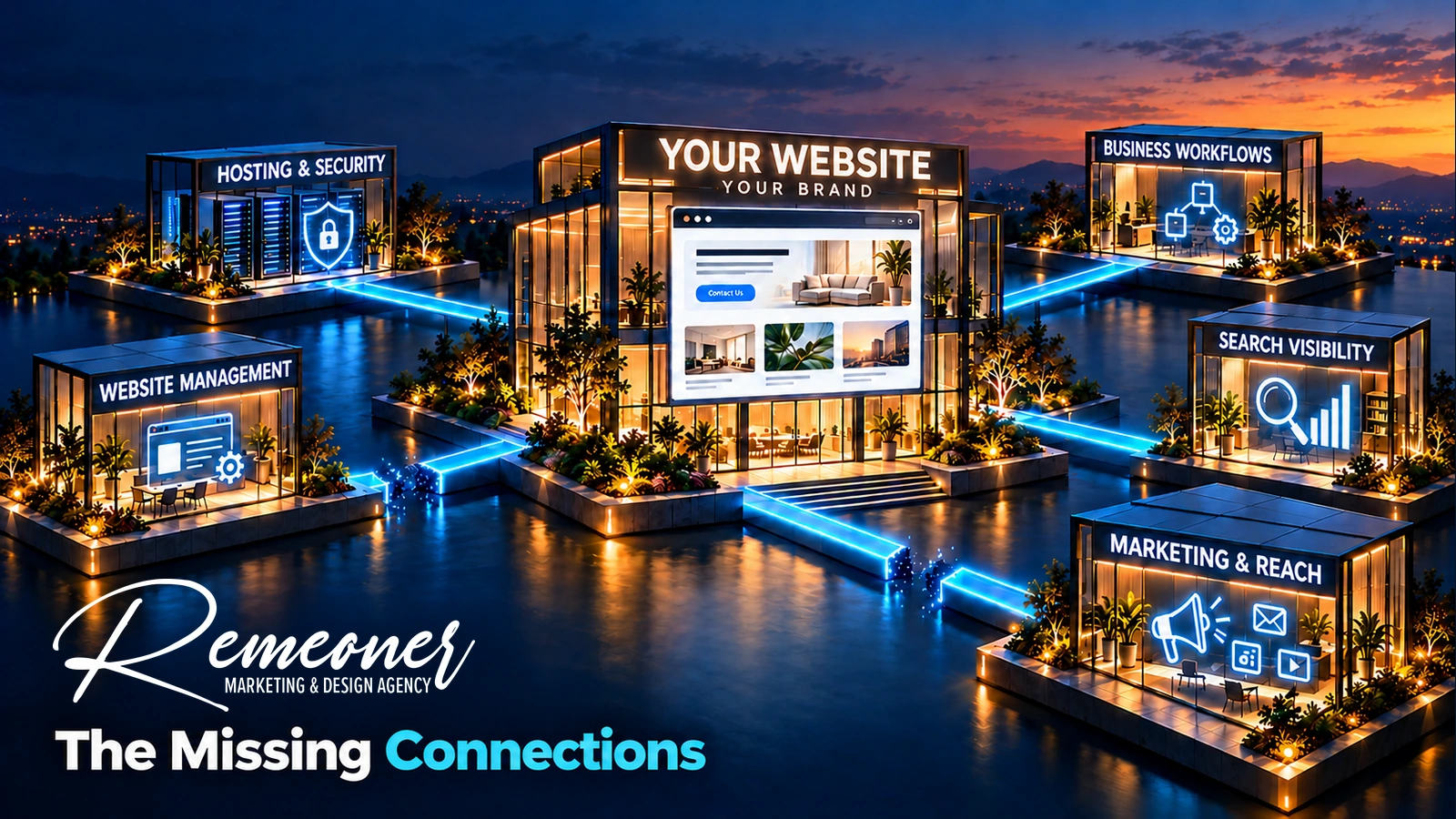
Rather than treating the website, social media, email, search visibility, and other communication channels as disconnected activities, we examine how they can work together to support specific business objectives.
The website often serves as the central destination, but not every business requires the same channels or publishing frequency.
We begin with the audience, the business’s expertise, and the opportunities worth pursuing.
From there, we develop meaningful messages, determine where those messages belong, establish an appropriate cadence, and evaluate performance.
The objective isn’t simply to keep a website updated or a social media account active.
It’s to help businesses communicate what they know, demonstrate what they can accomplish, and develop additional pathways for discovery.
Because the work you’re doing today may contain the very insights that help tomorrow’s customer find you.
Before You Have to Reintroduce Yourself
Take another look at your business.
Not through the eyes of a longtime client who already knows your value.
Not through the eyes of a colleague who has recommended you for years.
Look at it through the eyes of someone encountering your brand for the first time.
Someone who has a problem you know how to solve.
Someone who might be willing to hire you tomorrow.
Would they discover you?
And if they did, would they recognize everything your business has become?
If the answer gives you pause, that doesn’t necessarily mean you need a new website, a new brand, or a larger advertising budget.
You may already have a strong foundation.
You may simply need a clearer strategy and a more deliberate rhythm for communicating your value beyond the audience you’ve already earned.
There’s nothing wrong with being found through the relationships you’ve built.
But relationships change. Contracts end. Markets evolve.
And the next person who needs your expertise may have no connection to the people who already know you.
Don’t wait until your existing audience stops calling to introduce yourself to the audience that hasn’t met you yet.
Frequently Asked Questions
What is the difference between a website and a marketing strategy?
A website gives customers a place to learn about your business and take action. A marketing strategy identifies the audiences, messages, and channels that can help you reach prospective customers. Website development builds the asset; strategy determines how it supports your business goals.
Does an SEO-optimized website need regular updates?
Not every website needs frequent new content. Review whether your pages still reflect your services, answer customer questions, and provide accurate information. Make updates when they improve usefulness, rather than simply to meet a publishing schedule.
Why isn’t my website generating more leads?
Possible reasons include too little qualified traffic, unclear messaging, difficult inquiry forms, or content that doesn’t address what prospective customers need. Search performance data and website analytics can help identify where to focus.
Can a business rely entirely on referrals and social media?
Yes. Some businesses thrive through referrals and social media alone. Whether that is sufficient depends on your goals, customers, and reliance on those sources. Additional channels may help you reach unfamiliar audiences and reduce dependence on a limited network.
What happens after a website launches?
Depending on your goals, the next steps may include measuring performance, refining content, developing a marketing strategy, improving search visibility, and implementing campaigns. Confirm which ongoing responsibilities are included in your agreement and who will carry them out.
Your Next Opportunity May Be Outside Your Existing Network
Remeoner helps businesses and nonprofit organizations develop connected marketing and design solutions that bring their websites, search visibility, branding, and communication channels into alignment with their goals.
Whether your business needs a clearer marketing strategy, help implementing an existing plan, or a stronger digital presence that reflects everything you’ve become, the first step is understanding what you’re trying to accomplish.
Let’s discuss how to make your business easier to discover—not just easier to find.